
On February 7, the National Institute for Health (NIH) published Supplemental Guidance to the 2024 NIH Grants Policy. This new guidance sets as “a standard indirect rate of 15% across all NIH grants for indirect costs in lieu of a separately negotiated rate for indirect costs in every grant.”
Definitions
If you’re looking at this page, chances are you already know what an indirect cost is, but just in case, here’s how NIH defines it:
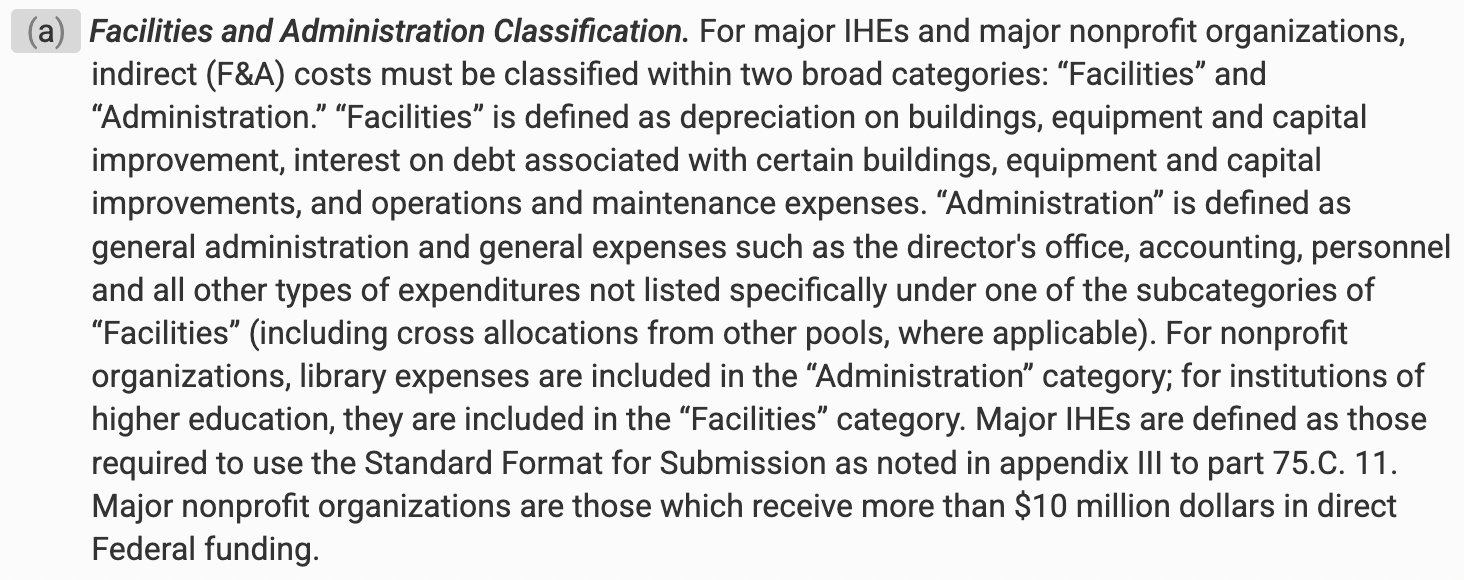
Direct costs cover the actual research itself, including salaries, travel, equipment, and supplies directly supporting the grant-supported project or activity. Direct costs that would not be incurred if the grant did not exist.
Indirect costs are sometimes called overhead. They refer to the expenses associated with running the institution that is home to the funded research project, including things like equipment, utilities, building maintenance, rent, administrative officers’ salaries, accounting department costs, and personnel department costs. Indirect costs are incurred independently of the funded research project, but the project depends on them to happen.
So, what’s an indirect cost rate? The NIH and philanthropies defines this rate as indirect costs/direct costs. This definition matters because it has led to real confusion.

In other words, when an institution claims an indirect cost rate of 50% that does not mean that half the money it is getting from NIH is going to indirect costs. It means that a third of it is (0.5/(1+0.5). Vivek Ramaswamy’s mistake is understandable coming from someone who just learned about indirect cost rates; it’s alarming coming from the former co-director of the Department of Government Efficiency.
Understanding how the indirect cost rate is calculated is important to understand just how severe these cuts are. A flat indirect cost rate of 15% means that indirect costs will only account for 13% of the total funding for all projects (indirect cost/total cost). The total indirect costs NIH grants in 2024 was 29% of the total funding, or an indirect cost rate of 40%.
What’s Wrong with this New Rate?
The argument that the Trump administration is making for switching to the flat rate is that private funders provide a much lower indirect cost rate than the NIH does. This is true. But is it a justification for using a flat rate of 15% instead of letting NIH determine the appropriate rate on a case by case, institution by institution basis? DOGE and the Trump administration want to treat the federal government as if it were just another private corporation.
It is a basic (and very bad) category error to regard the government as a private organization. It is, by definition, not.
This distinction is important because, although it cannot be disputed that the NIH provides a more generous subsidy to scientific research than most private funders do, it is legitimate to ask whether the federal government should provide that subsidy? I am inclined to say it is and not only because the return on that investment is large. (In fiscal year 2023, NIH funding generated an estimated $92.89 billion in economic activity.) I think that one of the reasons we have a government is to support good things that the private market won’t .
Even if you think the government could learn something from the private sector about efficiency and return on investment and suspect that some institutions are taking advantage of the NIH’s indirect cost rate, that is no justification for imposing a fixed rate on indirect costs for existing and future grants. As it did with the Office of Management and Budget, the Trump administration is using the suspicion of a misuse of funds in a federal program as the justification for breaking the program. It is not just possible but also proper to investigate fraud first and then freeze funding, but this administration appears to have no interest in the investigation. Defunding science is the point, not the process.
Potential Impact of Change
So, how much will a flat 15% indirect cost rate mean to institutions and states? That’s not a simple number to determine, but I tried. You can see the methodology at the bottom of this post. These numbers should be treated as approximations, not exact amounts.
Total funding lost by each state (link to interactive):

Impact on Institutions
Here are the 50 institutions that will lose the most money as a result of this change to the indirect cost rate. You can see the full list here.

Methodology
- I downloaded the entire list of grants NIH funded in 2024. That’s 65,073 grants. You can see the full list here.
- I calculated the sum of the indirect and direct costs and compared it to the funding for each grant. In most cases, those two numbers were the same.
- I narrowed that down to programs in the 50 states plus Puerto Rico and Washington, DC, which took the number of grants down to about 64,438.
- This is where the data gets messy and I cut some grants out. These are the ones I cut to end up with a final count of 53,183 grants (There is some overlap in these categories, which is why they do not sum exactly to 64,438).
- There are 129 grants that received less than $500 in funding (123 received $1).
- There are 9,149 programs for which the NIH reports no indirect costs, indirect costs of $0, negative indirect costs, or no direct costs.
- There NIH provides the total of direct and indirect costs for each grants and the total funding provided by NIH to the grant. In 2,151 cases, those total were not equal, so it was not possible to determine how much funding was allocated to indirect costs.
- For the remaining 53,185 I calculated the adjusted funding total based on a 15% flat indirect cost rate, using this equation:
- (Direct Cost)+(0.15*Direct Cost)=Adjusted Funding
- I calculated the lost amount of funding by subtracting the adjusted funding from the actual using this equation:
- Actual Funding – Adjusted Funding = loss
- I created pivot tables for the 50 states, DC, and Puerto Rico. I used that data to create a map in Datawrapper showing total loss by state. Unfortunately, I could not include Puerto Rico or DC due to limitations on the website.
- I created a pivot table of institutions and used it to make the chart.
4 responses
[…] based on the nearly $630 million in NIH funding its institutions received in 2024, according to an analysis by a policy leader at Education Reform […]
[…] based on the nearly $630 million in NIH funding its institutions received in 2024, according to an analysis by a policy leader at Education Reform […]
[…] the Mayo Clinic and the University of Minnesota are the chief recipients of NIH research grants. A preliminary estimate by education policy analyst James Murphy finds that the U stands to lose around $62 million annually under the new formula, while the Mayo […]
[…] law, all applicants for N.I.H. grants divide their budgets between “direct costs” — the research itself — and “indirects,” which are more general […]