
On August 15, 2025, the Department of Education published an announcement that it would be adding a new component this year to IPEDS, the survey that institutions of higher education are required to complete every year. The Admissions and Consumer Transparency Supplement (ACTS) was created in response to a White House executive order that called out the need to “expos[e] unlawful practices and ultimately [rid] society of shameful, dangerous racial hierarchies.”
Although the new survey component is a product of the administration’s obsession with race and its strategic weaponizing of civil rights law against elite universities, many advocates for a new social contract between higher education and the nation saw some potential good coming out of ACTS. Increased transparency into the college admissions process could help us all identify ways to make the process fairer and increase access to opportunity.
Unfortunately, as outlined in the announcement, ACTS was not going to deliver on that potential. It had far too many problems, among them the massive size of the component; the lack of time to prepare to complete it; undefined data fields; requests for data that colleges may lack; and the lack of staff at the Department of Education to help provide guidance and support to institutions.
With all these problems, it’s no surprise that over 3,000 comments were submitted during the initial 60-day comment period. The most common issue raised was concern “about the adequacy of the timeline for implementing new data reporting requirements of this magnitude, both for institutions and for the IPEDS program.” The second most common concern was about “data quality and standardization.”
By law, the Department of Education must read all submitted comments. There is nothing in the law, however, that says it must make any meaningful changes in response. That becomes very clear once you look at the new details about ACTS that were published in the Federal Register on November 13. The Department of Education apparently read through the comments and decided to change almost nothing. They essentially dismissed the concerns about timing and data quality.
Here is the most important thing to know about the ACTS survey component: it is happening this year. Four-year colleges and universities that do not admit 100% of applicants will be sent an ACTS survey next month, and they will need to complete it by March .
You can submit a comment on this new announcement until December 15.
What We Learned About ACTS
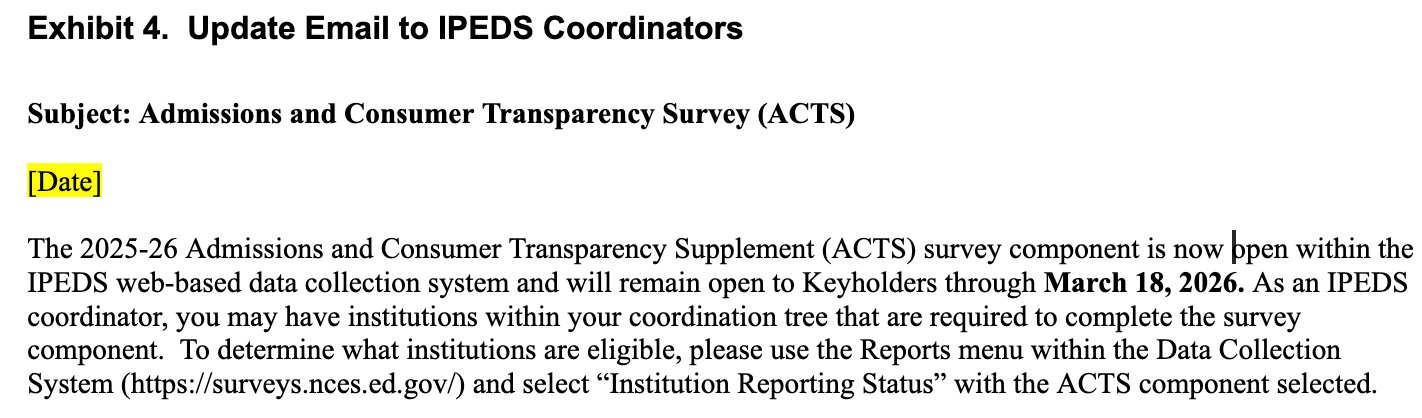
The information below comes from several documents available under the announcement’s “forms and instruments.” Because they’re Word docs, it’s tricky to link to them, so I use screenshots instead.
Beware the IPEDS of March
The deadline to complete the survey in the current documents is March 18, 2026 (okay, not quite the Ides of March). That date might change since the 30-day comment period on this new announcement does not end until December 15, 2025, and the March 18 deadline was likely based on the survey opening on December 3.

Messing Up Could Be Expensive
According to a sample letter in Appendix B, to be sent as the deadline for the survey approaches, “Institutions have been fined for failing to submit complete surveys on time. Title IV, HEA program regulations 34 CFR 668.84, 668.85, and 668.86 permit a fine of up to $71,545 for each violation.”
Not Everyone Needs to Do It.
Two-year colleges and institutions that admit 100% of applicants do not need to complete ACTS. This confirms what most experts expected all along.
ACTS is Using a Whole New Submission Process
The first step in the ACTS process will be to create an anonymized file for every single person who completed an application to a college or graduate program each year. Those files, which will not be shared with the Department of Education, will then be uploaded into the ACTS Aggregator Tool, which will then create aggregate data files for undergraduates and graduate students, which are to be downloaded and then submitted to the IPEDS Data Collection System (DCS).
Here is what will be in the unit-level files for applicants, admitted students, and enrolled students.

As I’ve noted before, asking for the family income of all applicants is a bad idea since admissions offices will not have that information. Income data typically comes from the FAFSA, and many students will send the information from the FAFSA to a college later in the process or not at all. Also, if you’re not sure how much you trust these individual files not to end up in the federal government’s hands sooner or later, I’m not here to call you paranoid.
We Finally Know What ACTS Will Ask about Grad Students
There is a lot of overlap here with questions about undergrads, with a focus on race, sex, test scores, income, and financial aid. Strangely, the Grad component of ACTS does not ask about applicants’ college GPA.

ACTS Will Require 7 Years of Data
The 2025-26 ACTS survey captures data not only from the 2025-26 academic year but also from the five prior academic years. Admissions data will cover 2020-21 through 2025-26. Because graduation rate data covers the previous year, ACTS will also include data from 2019-20.
It’s important to recognize that this was a particularly tumultuous time period for higher education and figuring out what forces shaped any single freshman class will be very difficult.
- Variations by Admissions Cycle
- 2020-21: admissions policies, admits, and acceptances were not significantly affected by COVID but enrollments were.
- 2021-22: COVID affected every part of the admissions process, including a nearly universal expansion of test optional or test blind policies, due to a lack of access to testing sites for the HS Class of 2021. COVID also likely affects retention and graduation rates, as well as levels of college readiness.
- 2022-23 to 2025-26: COVID effects waning but present, but more than 80% of colleges remain test optional or test blind.
- 2024-2025: First class admitted post-SFFA.
ACTS assumes that colleges and universities even have seven years of data, especially for people who applied and were rejected. As I’ve noted elsewhere, asking for this many years of data could very well break the rules of the Office of Management and Budget. Even if it’s legal, many schools will not have data going back that far.

It’s Going to Take Whole Lot of Time and Money
If all of this sounds like a lot of data, you’re right. Institutions are being asked to fill out between as few as 9 data fields for rejected applicants and up to 32 fields for graduating students each year; the number of fields for graduate students ranges from 5 to 20. And to do it not just for this year but the previous five.
The Department of Education estimates that it currently takes 78.5 hours to complete the entirety of IPEDS but completing ACTS will add 200 hours this year and 40 hours in the years that follow. Assuming these estimates are accurate, completing the IPEDS survey this year will take 3.5 times longer than it did last year. Keep in mind that at many smaller institutions one person handles all the institutional research needs. Completing IPEDS is just one small part of their job.

The Department of Education estimates that adding ACTS this year will cost an additional $2.5 million, which no institution could have budgeted for since these changes were only announced in August.

ACTS Forces Colleges to Assign a Gender to Students Who Do Not Indicate One
The ACTS codebook does not allow colleges or universities to indicate that a person’s sex or gender is “unknown.” Every single person must be “allocated to male or female.” There are many data fields where “unknown” is an allowed response, including race, income, parental education, and other categories. This is not an issue that originated with ACTS, but it has particular relevance since the primary data unit in ACTS is what the survey refers to as “race-sex pairs.” If that primary unit is compromised, then the entire survey component is compromised.

This decision not to offer “unknown” as response to questions about sex is especially odd since Part C of the Admissions survey component in this year’s survey already asks for that information.

Non-Submitters of Test Scores Remain a Problem
According to the Common App, just 5% of their roughly 1,000 member institutions require a test score to apply and 47% of their roughly 1.5 million applicants submitted a score. At many institutions, most of their students did not submit a test score. ACTS does allow non-submitters to be designated in the data, but what is not clear is how they fit into several important ACTS calculations. For instance, students receiving aid and first-year GPAs will be disaggregated by test score quintiles. Will non-reporters be included in that calculation as a sixth category? It would certainly be valuable to see nonsubmitters’ first-year GPAs or their graduation rates.

Privacy Issues are not Resolved.
Given the extensive disaggregation and slicing up of data in ACTS, it is certain that the number of individuals in some cells will be so small that they cannot be broken into quintiles or that they run the risk of revealing private information. At Harvard, for example, there were only 3 students who identified as American Indian in the freshman class. Revealing data about a group that small could easily expose those students. What is alarming about this announcement is that it contains no information about suppressing data in the case of small cell sizes. On the contrary, the response the Department of Education made to concerns raised during the first comment period indicated that they might ignore this issue.

Non-Credit Courses
ACTS will have questions about students in remedial and continuing education courses that were floated as a possibility in August are being added. I cannot see the logic in including continuing education courses for first-time students.
Parental Education
The question about parental education will be a yes/no question about whether a parent “completed college,” rather than asking what their highest level of attainment was.This is basically a question to identify first generation applicants. If you’re reading this post, you’ve probably already asked yourself, “What do they mean by college?”
When people in college admissions talk about first generation status, it usually means that neither of the applicant’s parents attained a bachelor’s degree. That is not going to be the case for ACTS. According to the codebook, completing college means getting “an award” and it does not have to be from a college or university. According to this definition, an applicant whose father has a certificate from a barber’s academy would be grouped with someone whose mother has a PhD. Also problematic is the assumption that the Department of Education is making that admissions offices will have this information about all applicants because it is included in the FAFSA. As I’ve noted in other posts, colleges frequently do not have FAFSAs for applicants.

High School GPAs Will Be Unweighted (But Maybe They Don’t Need to Be Reported?)
The individual data files colleges and universities need to create for every single applicant have to include an unweighted high school GPA. There is no direction on whether that GPA includes only core academic courses or all classes. There is no direction on how to calculate an unweighted GPA if a student or transcript only reports a weighted GPA. There is no direction on what to do with transcripts that do not report letter grades on a 4.0 scale.
There is, however, an escape clause for institutions. According to the codebook, “if [an] institution does not use the secondary school GPA in the admissions decision,” it does not need to submit this data point. In other words, just about every college and university that uses a holistic admissions process will be able to leave this field blank. College admissions offices look at the rigor of a student’s coursework and the grades they got in those classes, not GPAs.

ACTS is really not about Merit or Transparency
No questions about legacies or applicants connected to donors have been added to the survey, nor are there questions about recruited athletes. As a result, the data coming out of highly selective colleges will be impossible to interpret accurately, since legacy and donor preferences and athletics have a very significant impact on who is admitted to a college. The decision to leave questions about legacies and relatives of donors out of ACTS also tells you everything you need to know about how serious the Trump Administration and its allies are about meritocracy.
This might be the most important box on the ACTS survey for IR offices.

Will We Be Able to Trust ACTS Data When it is Released?
Would you eat a hamburger made from questionable meat ground at an understaffed processing plant for a restaurant where the boss just fired most of the employees because he wants to shut the whole place down? That’s basically what’s on the menu with ACTS.
Given the size of this survey, the absence of a normal vetting process involving experts in enrollment management, the speed at which this is being pushed through, the hours and dollars completing the survey will require, the current state of the data, the weak guidance on completing it, layoffs at the contractor that does much of the technical work on IPEDS, the absence of staff and weak morale at the Department of Education, and the general state of uncertainty the country is living under, it will be hard to feel confident in the ACTS data when it comes out. Even if everything goes perfectly, that data will be released under a cloud of suspicion and bad faith.
I suppose that cloud could still be lifted if ACTS was delayed for a year and revised in partnership with stakeholders, but I’m not holding my breath. When the data come out, I’ll probably be holding my nose.

Leave a Reply