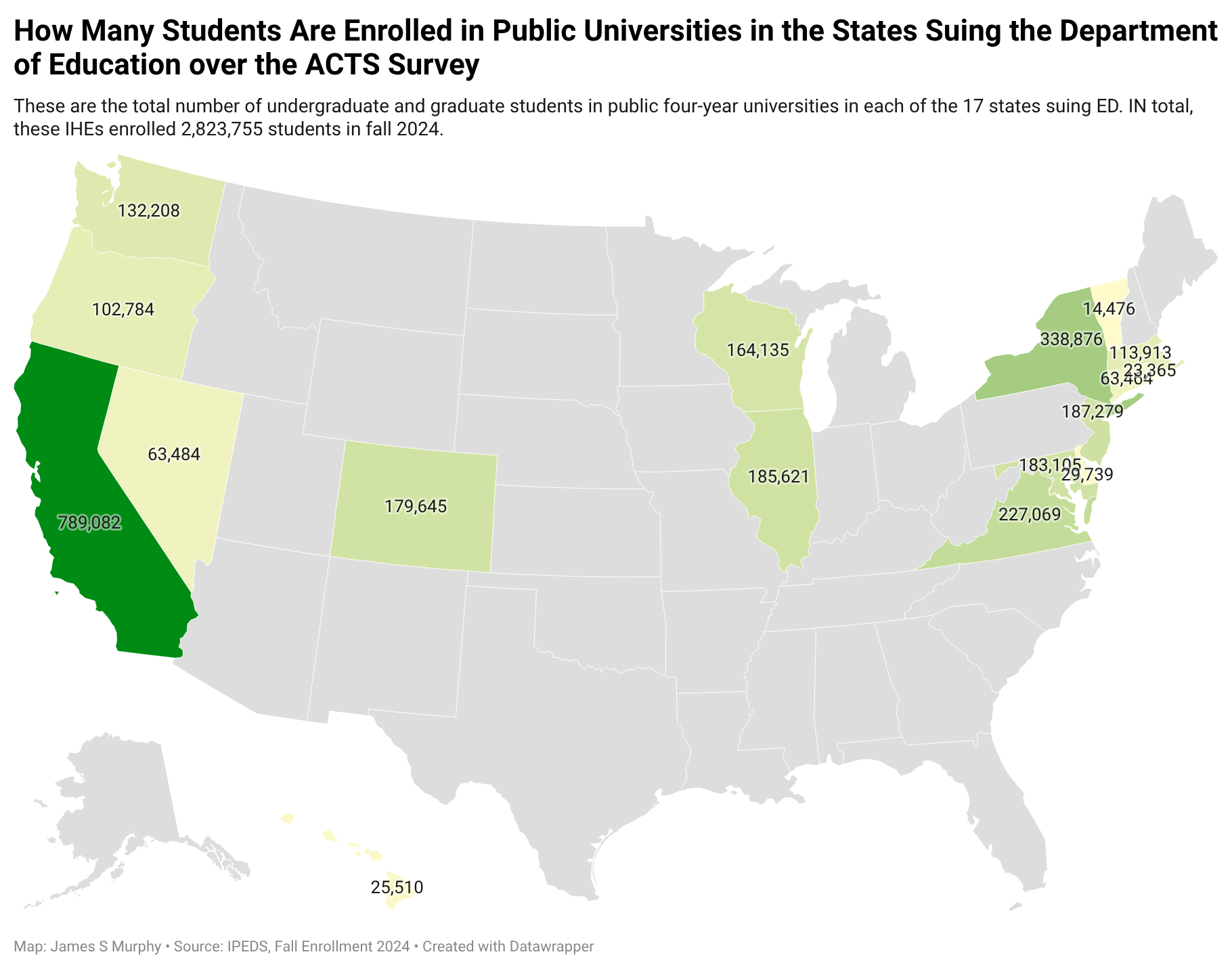
On March 24, a federal court heard the request by seventeen state attorneys general to pause the ACTS survey component. Judge F. Dennis Saylor (a George W. Bush appointee), had already extended the deadline for the massive data collection affecting as many as 2,000 colleges and universities from March 18 to March 25. At the end of an hour-long hearing, during which the judge seemed skeptical of the claims made by the Trump administration, the Department of Justice attorney asked that any injunction the judge might put on the order to complete ACTS would be limited to public institutions of higher education in the seventeen states that filed the original complaint. After the judge suggested he would do that, the attorney representing the seventeen plaintiff states said they would have no problem with that limitation.
I almost stuck my head out the window to see if I could hear the screaming coming from the half dozen private colleges around where I live, near Boston.
The judge ultimately decided to push the ACTS deadline for public colleges and universities in the plaintiff states to April 6, in order to give the plaintiffs and defendants time to provide any further evidence or argument before he issued a decision on whether to hit pause on ACTS for the plaintiffs’ institutions. The deadline for everyone else presumably would be March 25–the next day!
Although it might look like the state attorneys general threw public institutions in the other 33 states and private colleges and universities everywhere under the bus,the judge’s hands were tied by a 2025 Supreme Court decision. Trump v. Casa which held that “universal injunctions likely exceed the equitable authority that Congress has given to federal courts.” In other words, any injunction the court might put on ACTS could only apply to the plaintiff states and the public universities and colleges they represented. By failing to file a suit themselves, private colleges and universities had thrown themselves under the bus.
On either March 24th or 25th, the Department of Education notified institutional research offices that the deadline for submitting all ACTS data had been pushed to March 31, unless the institution was a public one in a plaintiff state. All institution’s could still request an extension until April 8 (all are subject to change). As a result, we now have three deadlines for the ACTS survey component:
- March 31: all private colleges & public colleges in 33 states
- April 6 : public colleges in the 17 states that filed suit against the Department of Education
- April 8: all colleges granted an extension
On March 25, the Association of American Universities filed a memorandum seeking the same relief granted to public universities for its 69 members not already covered by the stay. The AAU complaint provides a glimpse of how poorly ACTS has been implemented at a technical level: “Compounding these burdens, the Department’s rushed implementation has been marked by conflicting guidance from the IPEDS help desk, technical problems with the Aggregator Tool as well as the software tool NCES offered as an alternative, and mid-collection changes to templates and definitions that forced AAU’s members to revise their processes and, in some cases, start over.” Expect other higher education associations to do the same early this week. Whether they will succeed remains to be seen.
I also expect the 17 plaintiff states will succeed however and that by April 6 they will receive a temporary injunction relieving them of the need to complete the ACTS survey until a court rules on the legality of the ACTS survey. I suspect that means that approximately 208 four-year colleges and universities will not be providing ACTS data at all this year. Those institutions enroll more than 2.8 million undergraduate and graduate students.
This decision will leave a large hole in the ACTS data, further compromising the already questionable value of the survey. Aggregate analysis of national and state ACTS data in plaintiff states will be essentially pointless. That’s not a reason to rule against those states, of course. It’s the reason to delay ACTS for all.
Leave a Reply