
The United States is the world’s leader in research.
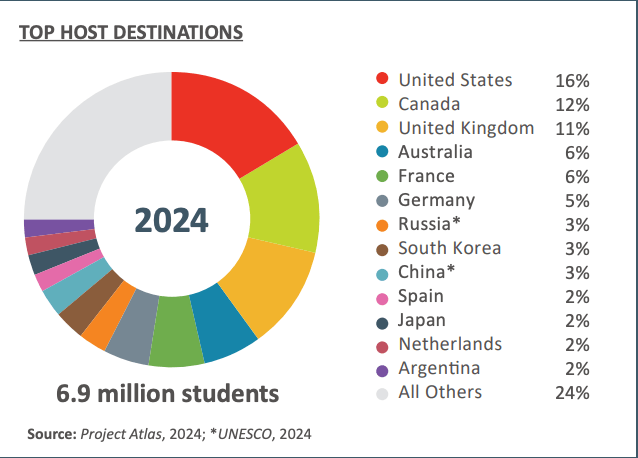
The United States is also the top destination of international students.
These two facts are not unrelated.
International students, particularly international graduate students, play a vital role in our nation’s prominence in science, health, technology, and innovation. There are many great universities and researchers around the world, but nowhere has as many of both as we do. Our universities attract talent from across the globe because students want to come to the United States to work with the leading scholars on the cutting edge of their disciplines. Many of those students stay here in the United States, becoming the next generation of professors, researchers and entrepreneurs. Almost half of the companies on the 2024 Fortune 500 list, which generated over $8 trillion in revenue in 2023, were founded by immigrants or their children.
The Trump Administration wants to destroy all this.
In its bizarre and ongoing effort to diminish the United States’s role as the world’s leader in research, the Trump Administration has set its sights on international students. For several weeks now, the President has been trying to figure out a way to stop Harvard University from enrolling any international students. The State Department has paused scheduling new interviews for students seeking a visa to study in the United States. Secretary Rubio has said that he’s going to revoke the visas of Chinese students with ties to the Chinese Communist Party or studying “sensitive subjects.” And immigration officials may restrict international students’ access to Optional Practical Training, which lets recent graduates extend their visas to work in field relevant to their degree
President Trump has justified this attack on international students and the universities that enroll them by claiming that international students take seats from American students. The Secretary of Homeland Security, Kristi Noem, declared, “It is a privilege, not a right, for universities to enroll foreign students and benefit from their higher tuition payments to help pad their multibillion-dollar endowments.”
Leaving aside the fact that no university–no matter how expensive–is using tuition to build its endowment (good luck if they are!), the framing of both Trump’s and Noem’s claims betrays their lack of understanding of the international student landscape.
Mapping International Students
To begin with, just five percent of U.S. higher education students are international, although in some states the percentage of students who are international is higher.
The percentage of higher ed students who are international does not fully capture which states will be hurt if the Trump Administration succeeds in heavily curbing international enrollment. Texas and Florida, for example, stand to lose tens of thousands of students.
It’s not just about money
Losing international students will financially hurt some institutions, but thinking that colleges only see dollar signs when they look at international students is a mistake. To be sure, there are institutions that heavily recruit and enroll international students at the undergraduate level because they are enticed by the promise of students who can pay full freight. But, that’s not the whole story.
Clay Hensley, an expert in international admissions, told me that one of the reasons some universities rely more heavily on international students is that they are not as successful at drawing students of the same caliber from across the U.S. as, for instance, the Ivy League is. Only a few flagships, such as the University of Michigan or University of Virginia, can reliably draw out-of-state students, who, like international students, tend to pay significantly more than in-state students do. For instance, top research institutions like the University of Illinois and the University of Washington enroll a lot of international students, as Jon Boeckenstedt shows in this post about freshman migration, but that’s in part because they don’t have the national draw that a few of their peers do.

Whether they are coming from another state or another country, these full-pay students may help subsidize in-state students The extra revenue they bring in may let universities keep costs down for residents or increase enrollment of local students. It should be said that the research on whether non-resident tuition revenue support residents in higher education is not conclusive.
Hensley also pointed out that money is far from the only reason colleges recruit international students. There are institutions that think having a more diverse student body is better for everyone on campus, and they recognize that talent is not limited to a few hundred U.S. ZIP codes. There are even a handful of colleges, like Amherst, Bowdoin, and, yes, Harvard, that believe so much in the value of having international students that they provide need-based aid to non-residents and even go out of their way to recruit students from less developed nations.
You Can’t Talk about International Students without Talking about Graduate Students
This argument that universities are enrolling international students because they pay more than American ones makes much less sense if we look at graduate school. I am sympathetic to the criticism, recently made in a New York Times op-ed, that some institutions enroll too many very rich international students at the undergraduate level, but that’s not really an issue about international students, per se. Elite colleges enroll too many rich kids from private schools, full stop.
Whis criticism fails to address or perhaps even understand is that the majority of international students are in fact enrolled in graduate school, particularly if we look at elite universities. It’s kind of shocking that the author of the Times op-ed does not mention graduate students once in the piece, even though they make up two-thirds of the international students at his own university.

The prevalence of international students in graduate programs is another reason to be somewhat skeptical of the argument that they represent little more than extra revenue. Many if not most students in medical school, law school, business school, and master’s programs are paying the full cost of attendance, whether they are residents of the U.S. or not. Some public medical schools and law schools do charge in-state tuition, but that does not provide any extra impetus to enroll international students over out-of-state ones.
When it comes to PhD programs, most departments worth their salt charge no tuition to students and, in fact, pay them a stipend while they study, teach and conduct research. Revenue is not driving the enrollment of international students in PhD programs. Research is. PhD programs recruit from a much smaller pool of applicants than undergraduate programs do, and they are typically much more narrowly focused on an applicant’s academic preparation and interests than bachelor’s programs are. Departments want to admit students who are prepared to dive in to the deep end of their discipline, and the fact is–to keep with the clunky metaphor–some of the best swimmers are not from the United States. More than 80% of international graduate students are enrolled at doctoral institutions because of the talent they bring to these universities, not because of the money.
The largest number of international students are enrolled at the universities that place the highest emphasis on research, often referred to as R1s. At some of these institutions, there are two, three, or even four times as many international grad students as international undergrads.

The heavy enrollment of international students in graduate programs at research universities also explains why the most selective institutions enroll nearly a quarter of all international students, even though they only enroll six percent of students overall.

The Trump Administration’s claim that international students take seats that should go to American students seems to be based not just in xenophobia but also on a misunderstanding about where international students are enrolled. For all their talk of merit, the President and his allies seem to think that universities should be using quotas to hold spots for Americans. That’s no way to maintain our status as the world leader in research and innovation.
###
This table includes every institution of higher education in the U.S. and its territories that enrolled at least one international student.
Leave a Reply to Trump’s Policy May Threaten Chinese Student Visas in the US – Writ of Mandamus Law firmCancel reply