

Republicans have finally passed their reconciliation budget bill. If there’s one thing people should know about this huge piece of legislation it is that it almost certainly going to do real harm to many of us and/or to people we care about for no good reason at all, for in fact a very bad reason. This massive transfer of wealth from the poor to the wealthy is a disaster for millions of people who will lose access to health care and food. It will leave most Americans worse off as interest rates and costs, including higher education, go up, all in the name of saving very wealthy people and wealthy corporations some money in taxes.
The endowment tax barely matters compared to the harm that cuts to Medicaid and SNAP will do directly to college students who rely on those supports and indirectly to public colleges and universities and to state financial aid, both which will likely receive less support from states trying to balance their budgets. I want to say all that up front because the college endowment tax is a very small, stupid part of a very large, cruel act of legislation.
What makes the new endowment tax surprising is that it is even smaller and stupider than anyone expected, thanks to Senate Republicans being outflanked by–of all things–small liberal arts colleges.
The GOP Embraces a Wealth Tax
The original higher education endowment tax was created in 2017 through another reconciliation bill. It established a 1.4% tax on institutions with
- endowments worth at least $500,000 per full-time equivalent (FTE) enrollment,
- at least 500 tuition-paying students, and
- more than 50 percent of the tuition-paying students living in the United States.
During the original negotiations, Berea College in Kentucky raised concerns that an endowment tax would harm its ability to carry out its mission of serving low-income, first-generation students. Berea charges students no tuition, and almost all of its students are eligible for a Pell Grant, which is provided by the federal government to students from low-income backgrounds. The college had a powerful ally in Majority Leader Mitch McConnell (R-KY), who supported a provision exempting colleges with fewer than 500 tuition-paying students, which would spare Berea. Even after the Senate Parliamentarian rejected this exemption, Republicans in Congress revised the law in 2018 to reinstate it.
The 2017 endowment tax raised relatively little revenue, which is not surprising since the vast majority of higher education institutions have small endowments. According to the latest data, the endowment tax affected fewer than 60 institutions, or about two percent of four-year colleges. These colleges and universities enroll less than one percent of students enrolled in four-year colleges.
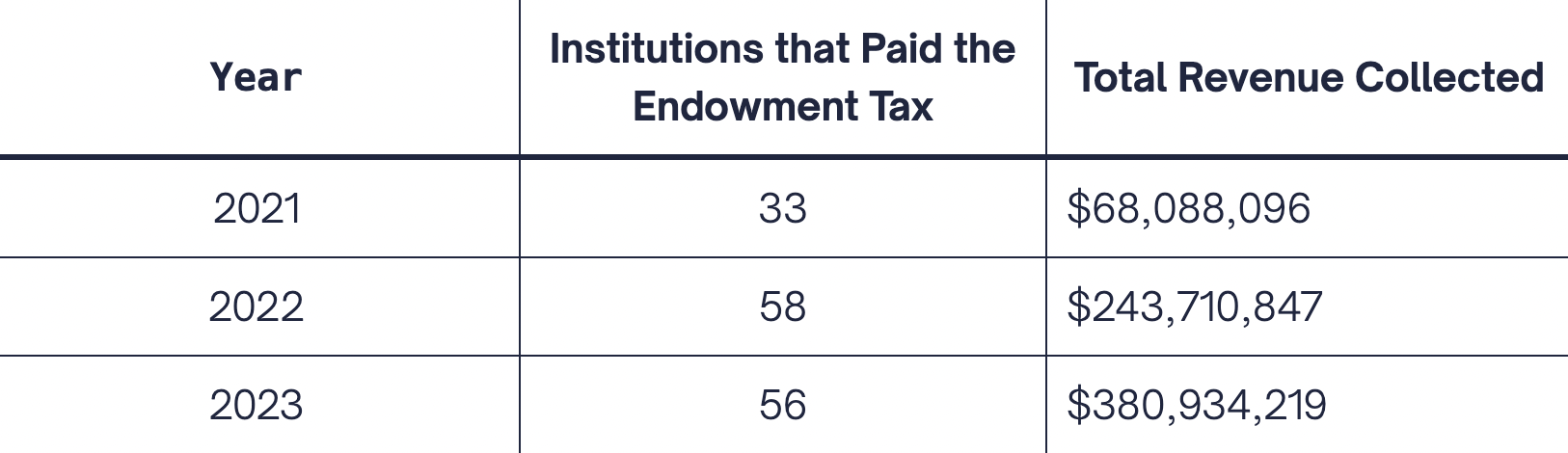
It did not take long for Republicans to notice how little impact the endowment tax had. They started introducing new bills that would increase the tax to 10%, 14%, or even 21% (i.e., the corporate tax rate created during the first Trump Administration). Senator J. D. Vance went a step further yet, introducing a bill that would set the tax rate at 35% for institutions with endowments worth more than $10 billion. These bills mainly served a symbolic function, displaying their sponsors’ disdain for elite universities (even if they earned a degree from them); in reality, they would never overcome the Senate filibuster as standalone legislation.
Unpassable bills is basically what reconciliation exists for, however, so when the opportunity arose this session, House Republicans introduced graduated increases to the endowment tax. Vice President Vance did not get his 35% rate, but the House bill did propose a 21% rate to the wealthiest universities.
It was a strange turn of events for a political party whose main policy idea for half a century has been cutting taxes for the rich. Apparently, House Republicans hate elite universities even more than they hate taxes, so much so that they embraced a wealth tax.
Davids Beat Goliath
The GOP wealth tax provoked a quick response from the president of Hillsdale College, who wrote an angry op-ed decrying Republicans for punishing “self-reliance” and “independence.” Senate Republicans heard him. Their final version of the bill, which the House signed onto and President Trump signed into law, completely spares Hillsdale.
But it also spares almost every other college in the nation.
Republicans wanted an expanded endowment tax, but what they ended up increasing even more than the tax rate was the number of institutions exempted from it. The final version of the legislation increased the requirement that an institution enroll at least 500 tuition-paying students to at least 3,000 tuition-paying students. Call it the Bigger Berea exception. What it means was that, in addition to Hillsdale slipping out of the tax, starting in 2026 dozens of colleges that had been paying the tax no longer will. The biggest beneficiaries are wealthy liberal arts colleges, such as Williams, Swarthmore, and Grinnell, but other small colleges, like Cal Tech and Juilliard, also got a tax cut. The final version of the tax also dropped a provision that used only domestic students to calculate the value of an endowment per FTE, which will likely spare institutions like Columbia and Johns Hopkins from paying the tax and may reduce the burden on some Ivy League schools.
It is not possible to know precisely who will pay the endowment tax and at what rate, since it will not going into effect until 2026 and will be based on endowment values and enrollment numbers from that year. The most reliable data we have on enrollment and endowment earning per full-time equivalent enrolled students is what colleges report to the Department of Education, but the last year for which that data has been published is 2022-23. I used those numbers for the chart below, but it is possible that some institutions will pay a higher tax rate based on 2026 endowment earnings. It is also possible that Smith, with about 3,500 students and generous need-based aid, might not actually meet the tuition-paying threshold.
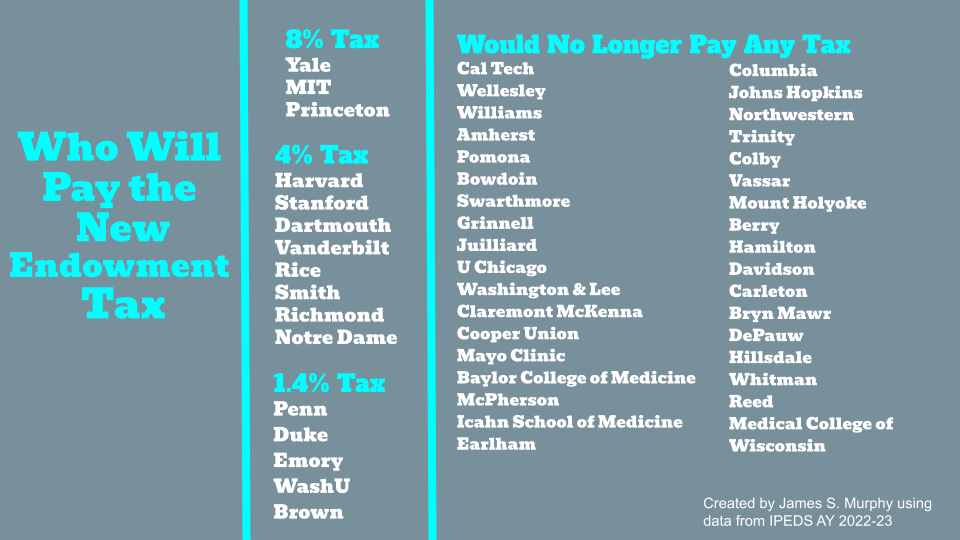
A month ago, higher ed leaders were expecting more colleges and universities to start paying the endowment tax and at much higher rates than before. Now, almost three-quarters of the institutions that used to pay the tax won’t. Wealthy liberal arts colleges, which also tend to rely less on federal research revenue than universities do, may actually be better off financially. While rates are going to be higher for the wealthiest institutions, they will be significantly lower than what the House reconciliation bill proposed. Even with higher tax rates, the new endowment tax will bring in less revenue per year than the existing version, according to the Congressional Budget Office.
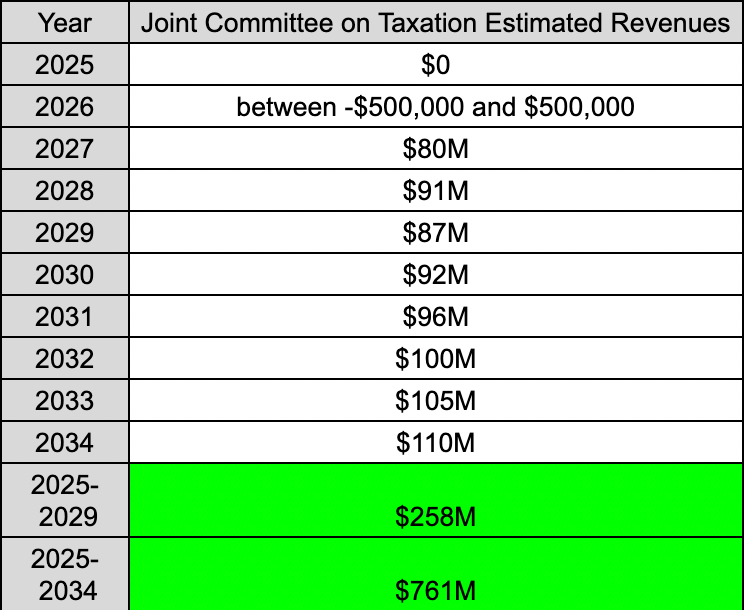
It’s enough to make you wonder why Congress bothered at all.
Leave a Reply