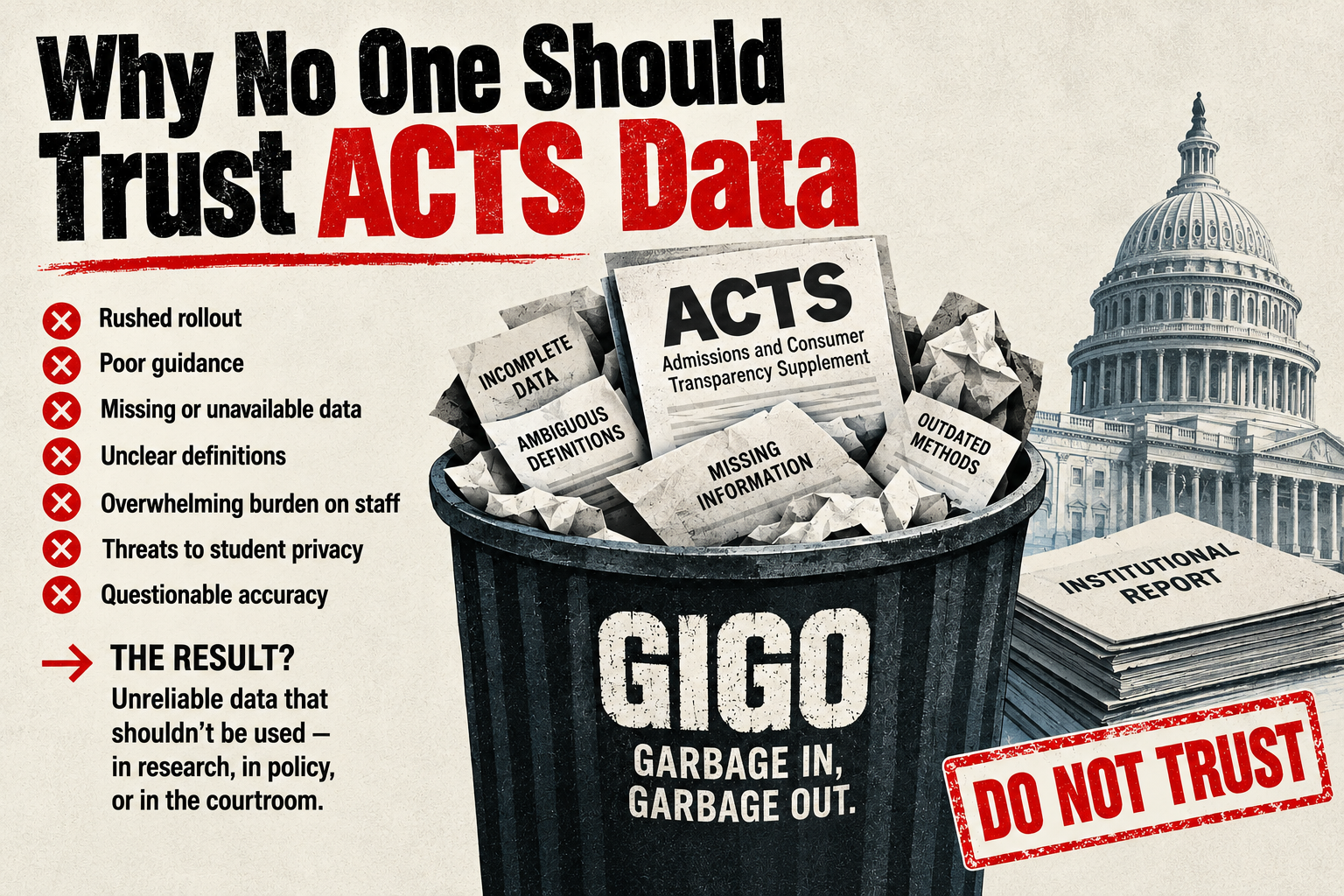
When the Department of Education’s National Center for Education Statistics (NCES) announced in August 2025 that it was adding the Admissions and Consumer Transparency Supplement (ACTS) survey component to the Integrated Postsecondary Education Data System (IPEDS), it was immediately obvious that any data gathered from ACTS was going to be of questionable value. I am a strong advocate for greater transparency in college admissions and outcomes, but there is no point in collecting data that is not trustworthy. In fact, collecting and publishing unreliable data is actually worse than having no data at all, since it undermines trust in IPEDS and empowers inaccurate and irresponsible analysis.
Thanks to a new report from the Association for Institutional Research (AIR) and the Urban Institute, we now know that the first ACTS survey collection went even worse than expected.
The report essentially confirms that no one–most of all anyone in the federal legal system–should trust ACTS data or use it as the foundation for making any legal complaints against a college or university. ACTS is a classic case of the GIGO design principle: garbage in, garbage out. Riddled with poor-quality inputs, ACTS can only produce poor-quality outputs.
No judge should take any claim based on ACTS data seriously, particularly after one federal judge issued an injunction against the data collection in seventeen states and for a couple hundred institutions. As he ruled, “The principal problem…lies not in the basic authority of NCES to collect, analyze, and make use of the data. Rather, it arises from the rushed and chaotic manner in which the ACTS was promulgated.” He characterized the implementation of ACTS as a violation of the Administrative Procedure Act (APA) that “epitomizes arbitrary and capricious agency action” and ruled that the plaintiffs suing the Department of Education are “likely to succeed on the merits of their claim that the agency action was arbitrary, capricious, an abuse of discretion, and not otherwise in accordance with the law.”
Here is a partial list of the technical and legal problems with ACTS that were obvious from the start:
- The survey was rolled out far too quickly with almost no stakeholder engagement.
- It implemented a brand new methodology for data collection and required institutions to report their data to NCES in a whole new manner.
- NCES provided poor guidance on a range of new data fields that institutions had previously never been required to track.
- Multiple data fields are so poorly defined that they cannot in fact be collected by institutions.
- Institutions do not have access to some of the requested data.
- Institutions are required to provide six years of application data, even though best practices in institutional research suggest purging older data from students who never enrolled.
- Institutional research offices and officers–many of whom are already overworked–had just a couple months to prepare for the new data collection; typically they have more than a year to do so.
- Data broken down by multiple characteristics will create subsets so small they will threaten student privacy.
- Collecting and standardizing graduate admissions data across departments and programs would require a difficult act of coordination.
- Diminished staffing at the agency makes timely guidance and training very challenging.
After surveying hundreds of institutional research staffers, AIR and Urban confirmed that these problems did indeed affect many campuses, and they discovered even more issues, including the following:
- The actual burden on institutional staff went well beyond federal estimates. The Department of Education estimated that ACTS would take 200 staff hours. More than half of respondents said their institutions spent at least 250 hours, and 28 percent spent 400 hours or more.
- Almost no one had all the data that ACTS asks for. Only 17 percent of respondents had all the undergraduate data ACTS asked for. Only 15 percent had all the graduate data.
- There is wide concern among institutional staff about the accuracy of their own data, due to ambiguous definitions and changing definitions. Fifty-two percent were very or extremely concerned about the accuracy of the data they submitted.
- Institutional staff paid a significant human toll in order to get ACTS data submitted, which means that institutions also paid a serious financial toll. Focus group participants described 60- to 80-hour weeks, small or one-person offices carrying the whole load, and colleagues who were considering leaving the field. Paying employees overtime, making up for staff burnout, and replacing staff who left their job likely meant that in aggregate ACTS cost many millions of dollars to implement, at a time when the federal government’s attacks on research funding, international enrollment, and other revenue sources are already creating financial duress at many institutions, not to mention the impact of rising costs affecting all Americans.
When the staff assembling ACTS data tell us not to trust it, the Department of Education (and the Department of Justice) should believe them. NCES should probably simply scrap this new survey or at least take the five recommendations the AIR/Urban report makes to improve ACTS:
- Clarify ACTS definitions, align them with existing IPEDS reporting, and keep changes between cycles to a minimum.
- Convene an ACTS Technical Review Panel.
- Improve technical systems and validation tools.
- Integrate ACTS more fully with existing IPEDS surveys and infrastructure.
- Strengthen privacy and transparency safeguards.
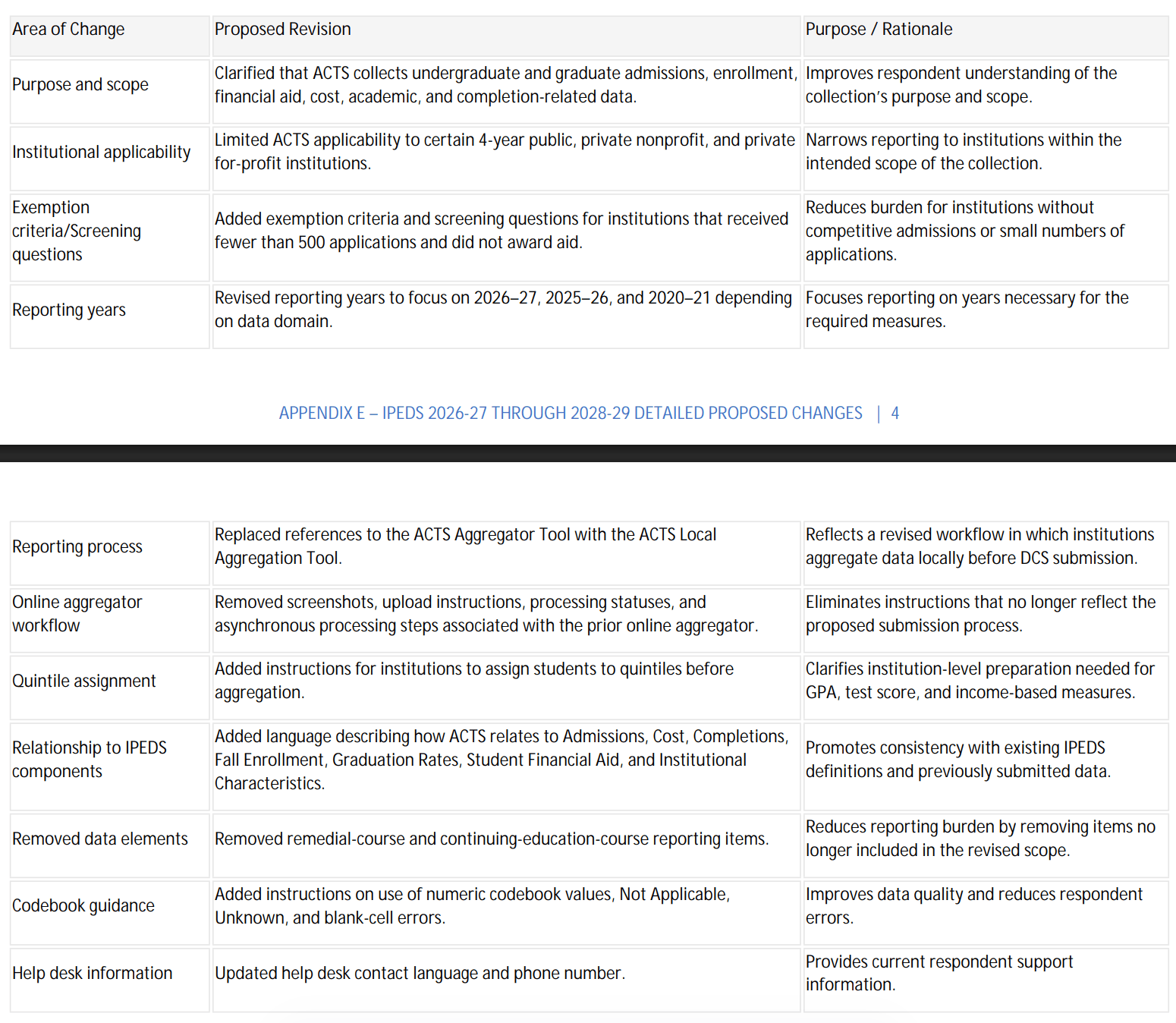
Last week the Department of Education announced proposed changes to ACTS that will go into effect when the 2026-27 survey goes out to colleges and universities in December. The changes do little to address the serious shortcomings of ACTS, but we should look at them as a tacit admission of the survey’s failings in its first rendition. Perhaps it is just a coincidence that NCES proposed the changes a couple weeks after the AIR/Urban report was released.
The two largest changes (you can see the full list below or in Appendix E) are that NCES has reduced the number of institutions that will be required to submit ACTS data and it has modified the reporting process.
Starting this year, the institutions required to complete the survey must award bachelor’s and/or graduate degrees, accept less than 100 percent of applicants, and receive at least 500 applications per year. As a result, approximately 1,300 institutions will need to complete the ACTS survey this academic year.
The new reporting process is almost certainly being implemented in response to the multiple reports of technical problems with it last spring. While it’s good that NCES is fixing a broken system, any new system will require extra labor (and money) to implement.
These “improvements” to ACTS will do little to address the fundamental problems with the survey, which means that none of us should take seriously anything that comes from this deeply flawed survey.
Leave a Reply